


The Prize Was the Strategy: How Techlicious Matched a Chromebook to Its Own Readers
Techlicious is a well-known online information website that helps customers find new products and website recommendations. Their content is focused on product reviews and analysis to help customers take the best decisions based on prices and technical requirements.
Author

Charlotte Czarnota

United Kingdom
Content Marketer
Products Used
Integrations Used

Date of Publication
Running a Successful Giveaway for 13 Days
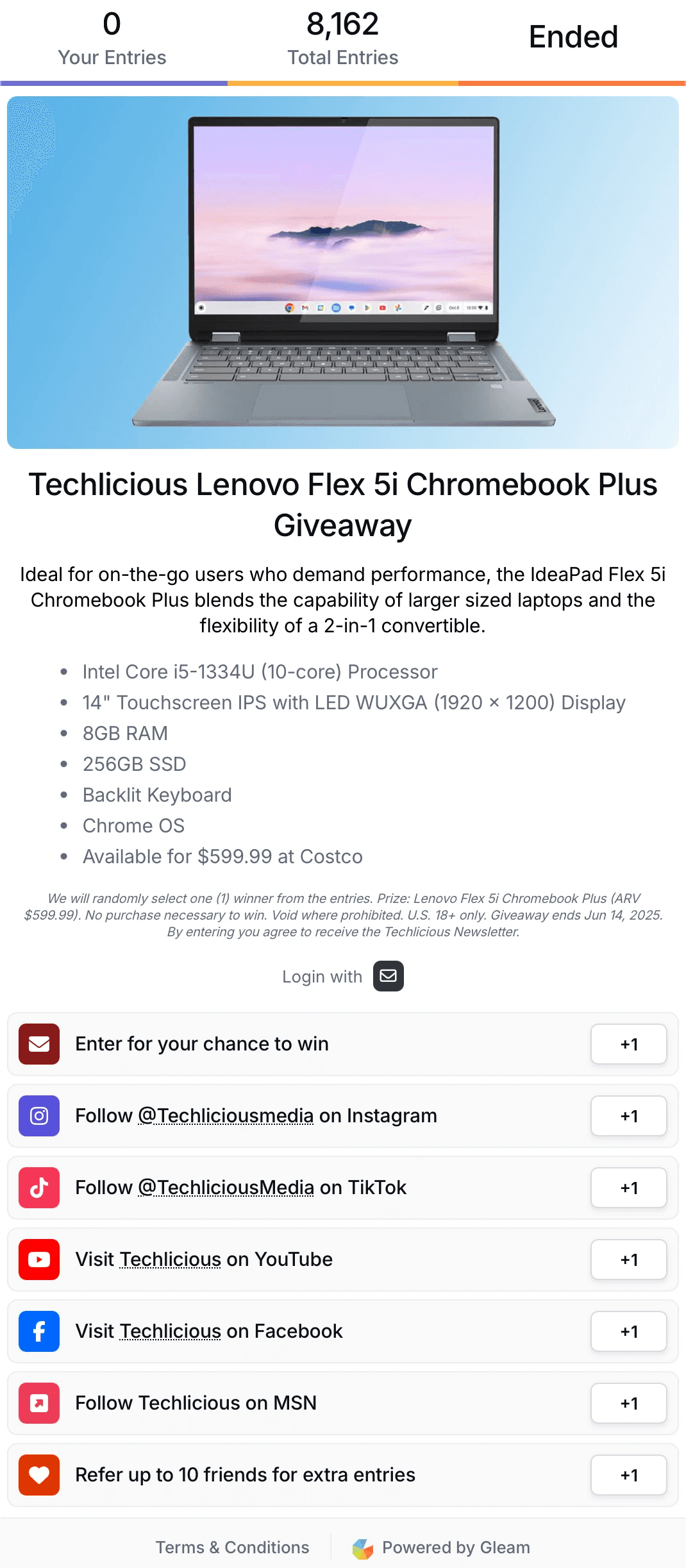
As part of the Marketing Stack, Techlicious has been running giveaways using Gleam for years. Their goal: grow their newsletter and social audiences.
"
"People would rather win a less expensive product they actually need than an expensive product that sits on a shelf. We've added tens of thousands of subscribers to our email list through Gleam campaigns, by far the most cost-effective way for us to acquire subscribers at scale."
Josh Kirschner, Founder and CEO, Techlicious
Techlicious's strategy for running giveaways has been simple: use Gleam Competitions to run competitions with prizes at a price their readers actually shop at, rather than top-shelf prizes that seem out of reach.
Give Away a Prize That Matters More Than Its Price Tag
The Lenovo Flex 5i Chromebook sits in the same world as Techlicious's Family and Parenting coverage: parental controls, school technology, student devices, practical household tech. A 2-in-1 Chromebook is not an abstract luxury item to that audience. It is the device a parent compares for homework, a student uses every day, or a household shares. It's a prize the reader already had a use for at home.

In that regard, choosing a prize on price alone does very little. What the prize is for, and how well it fits what your audience needs, is where the value sits.
Techlicious has learned over the years the same lesson Gleam found across 6,389 campaigns that had each passed 10,000 contestants: increasing prize value tenfold drove only about 13% more contestants, and prize value explained only about 2.6% of the variation in how many people entered. Price is not what pulls the numbers. Techlicious's answer to that is alignment, and this campaign is one piece of evidence for it.
Gleam's own prize research also names the risk. Premium consumer technology scores high on broad appeal and lower on audience qualification, which is a polite way of saying a Chromebook attracts people who just want a Chromebook. Techlicious did not manage that by spending more. It managed it by putting the prize in the same territory its readers already come to it for. The prize had broad appeal. The context gave it a clear audience rationale.
Based on that experience, they ran a 13-day campaign with a single winner competing for the Chromebook, converting 43.56% of everyone who saw the campaign widget.
One Required Action: The Email Opt-In
Based on their email list growth goal, Techlicious made a single action mandatory, labelled "Enter for your chance to win", which is Gleam's email opt-in action. Every new contestant was asked to subscribe to their list before completing any other action. Every other action in the widget was optional, but intended to accomplish the secondary goal of growing their socials.
The initial result was clear: when the prize is desirable, people hand over their email address. 2,159 of the 2,177 entrants completed it, and the remaining 18 started an entry without finishing that step.
The Newsletter Subscription Was the Start of the Customer Journey
A newsletter opt-in action on its own, with no thought given to what happens next, is worth very little. Data you cannot act on is worth nothing at all.
Those 2,159 subscribers did not stay in the Gleam dashboard once the draw closed. They synced into Techlicious's own Mailchimp list through Gleam's Mailchimp integration, reachable by the editorial team the same way any other subscriber is. Once a lead was captured, the end goal was to move them into the funnel with emails, nurturing their way into becoming regular readers, and even though only one winner got the Chromebook, the other 2,158 entrants went on to the list.
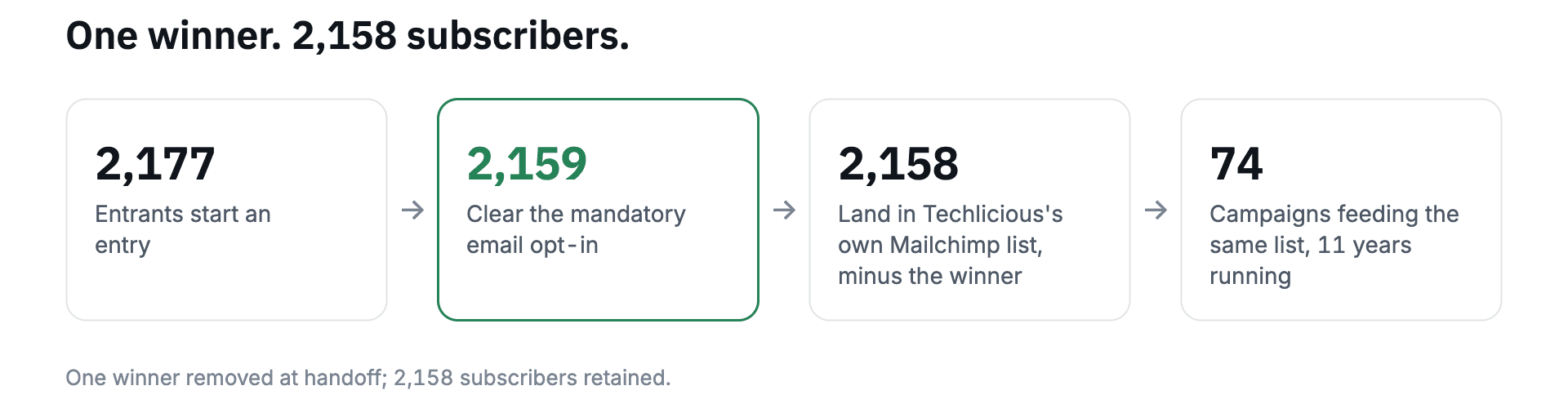
Put the email opt-in at the front of your widget and connect Mailchimp before you launch. Build your competition for free.
How They Built This Giveaway
Sometimes less is more, especially if your goals are very clear. They focused on just seven actions, one of them required. The order matters: consent first, channel engagement second, sharing last. All prioritised based on their campaign goals. The results confirmed their goals, and their hypothesis when building the competition.
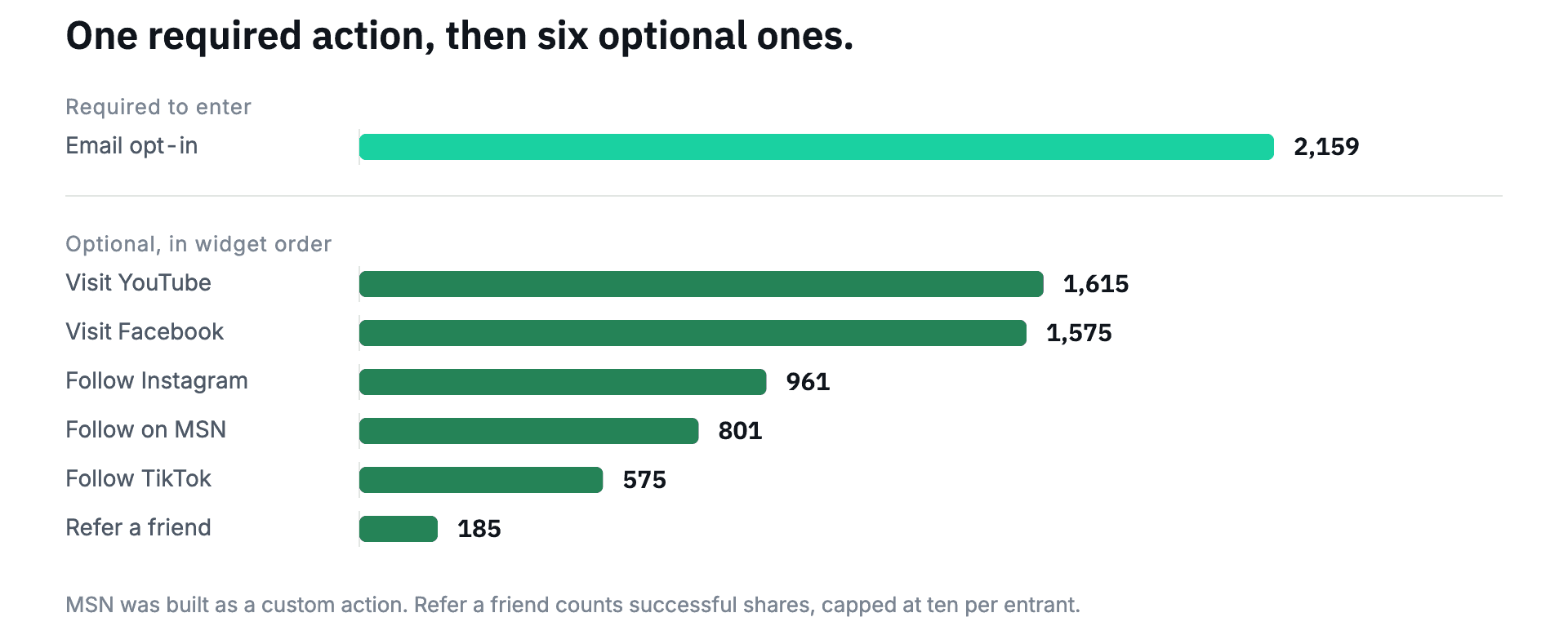
Required. Email opt-in, "Enter for your chance to win", completed by 2,159 entrants.
Visit YouTube, 1,615
Visit Facebook, 1,575
Follow Instagram, 961
Follow on MSN, 801, built as a Gleam custom action because there is no native one
Follow TikTok, 575
Refer up to 10 friends, 185 successful shares, capped at ten per entrant
That one required action was the floor, not the ceiling. 2,177 entrants produced 7,871 actions, an average of 3.6 each, and everything past the first action was voluntary, from people who already knew what the prize was and why they wanted it.
A Few Recommendations to Replicate Their Success
Before replicating their success, think of your goals first. Then place the main and strongest optional actions on top in the widget (in their case, visits rather than follows for YouTube at 1,615 and Facebook at 1,575).
Then build the rest of the actions as supporting actions, and add a viral share with higher entry value to make it more desirable.
If you want the participants to complete all the actions, consider adding a bonus action. Count the number of previous actions, set the required number, and add extra entries for those who complete them all.
How Referrals Worked
A referral action is a multiplier. It brings in people your entrants already know and you do not.
The refer-up-to-10-friends action drew 1,075 clicks and produced 185 successful shares, a 17.21% viral conversion rate.
That is not broad virality. Those 185 shares came from 94 people, just over 4% of all entrants, and five of them hit the full ten-share cap on their own. 185 successful shares from one action is still a real gain. The lesson is that the output concentrates, so build the incentive to reward the tenth share rather than assuming everyone will make a first one.
Use the Channels You Already Own
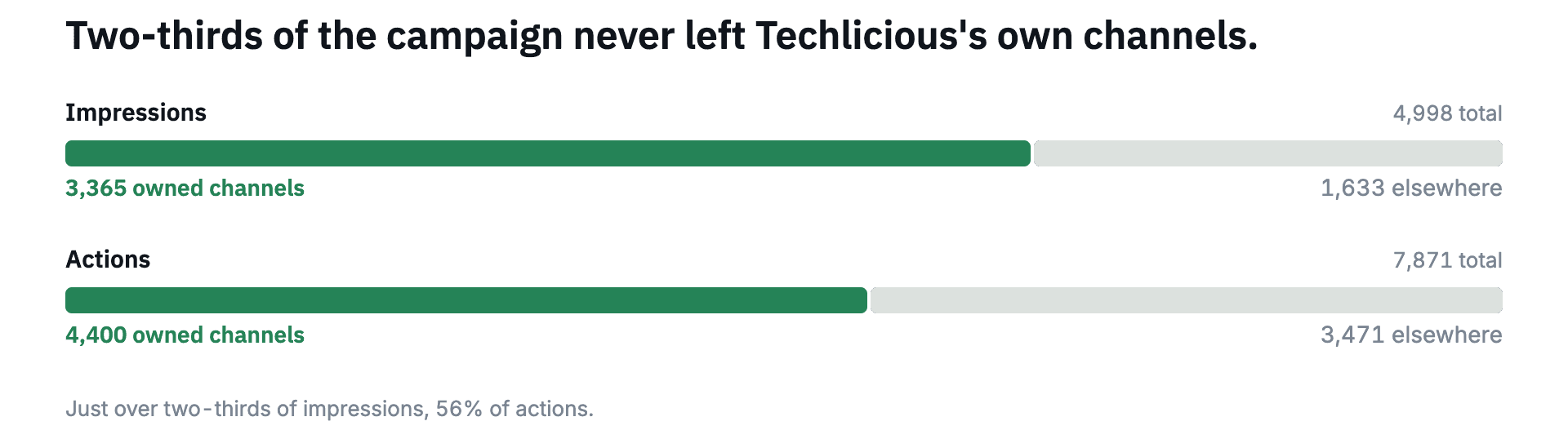
Techlicious's own blog post and the Gleam-hosted entry page produced 3,365 of the campaign's 4,998 impressions and 4,400 of its 7,871 actions. Just over two-thirds of the reach came from two pages the team runs itself; building on top of that is easier when you have a captive audience.
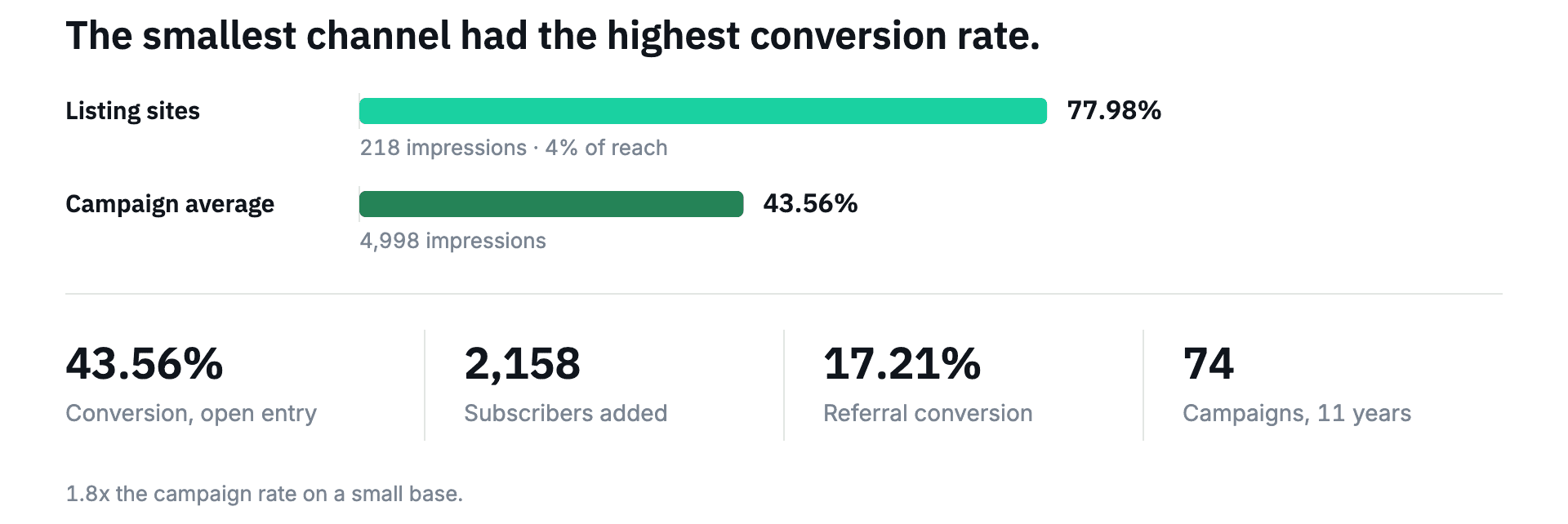
The most efficient channel was the smallest. Giveaway listing sites delivered 218 impressions, about 4% of total reach, and converted at 77.98%, roughly 1.8 times the campaign average. That is a small base, so treat it as a signal worth testing rather than a channel strategy. If you judge listing sites on impressions alone, you will underrate them.
Day Nine Beat Launch Day
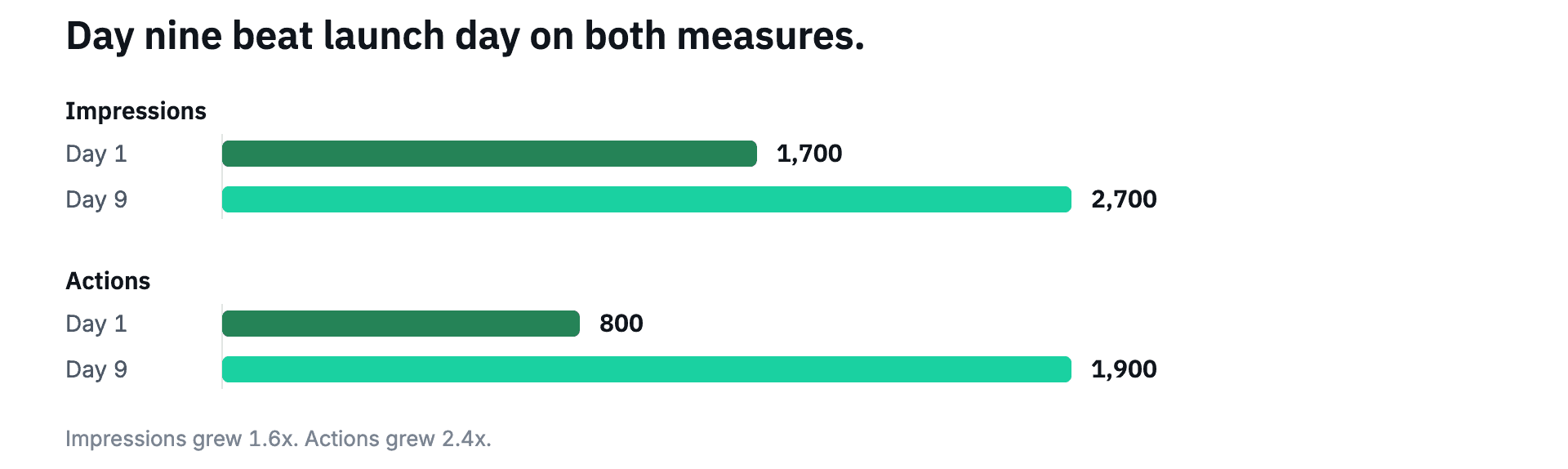
Impressions did not peak on launch day. The highest single day for both impressions and actions was day nine, most of the way through a 13-day run, before the campaign tapered to zero at close.
When you launch a giveaway, the first days are usually the peak. Keep promoting past that, and add extra actions later in the run so entrants can multiply their entries, and you will lift the numbers.
One final recommendation: before the giveaway ends, post a reminder on social media, or a banner on your site, to let entrants know it is about to close and create that final push.
Can You Do This Too?
Yes, if you copy the build and adjust to your goals. The mechanics are portable in an afternoon, and even though eleven years of audience trust and a defined editorial focus are not, you can start building from these as a recipe for success.
Pick a prize you know they want. Start with contestant intent, not with the biggest prize you can source. If your contestants would not search your own site for that product or similar, pick another product that is similar or directly associated with it.
Start from a Gleam Competitions template. Anyone can enter, with no existing subscription needed; the email opt-in sits inside the widget as the one required action. Set the prize, dates and eligibility, and build both entry points before launch: the embedded widget for your article, and the Gleam-hosted entry page. The template pages contain filters you can use per channel, per goal, and many more to ensure you are on the right track.
Make the email opt-in the one required action. Connect the Mailchimp integration before you launch, and test an entry end to end so you can watch the contact land in your list. Check Gleam's integration partners first; most major email platforms are there.
Add optional actions that match your channels. Copy the structure, not the channel list. Use a custom action anywhere Gleam has no native one, as Techlicious did for MSN. Start with your channels, from your website, your email list, and your social channels for a solid foundation.
Put the referral action last, and cap it. Ten shares is a sensible cap. Expect a small group to carry it.
Promote through your own channels first. Publish the article, embed the widget, use the hosted page as a second route in. Add listing sites as a test, not as the plan.
Read the action report while it is still running. Watch completions, sources and daily movement. If launch day is not your peak, you still have time to push again.
Consistency Over Time
When considering giveaways as part of the strategy to grow your business, having clear goals while doing it is the best recipe for success.
Seventy-four giveaways across eleven years is a setup being reused: a prize drawn from the topics the site already covers, one mandatory email action, a set of optional social actions, a capped referral, and a Mailchimp sync so every campaign adds to the same list. That is the part worth copying, and it is the part Gleam's Playbooks exist to make repeatable.
Start from a competition template, connect Mailchimp, and put the email opt-in action at the front of your widget. Then use the playbooks to pick the optional actions your audience will actually complete. Start a giveaway free or use this template.
About these numbers: all figures are Gleam dashboard totals for this 13-day campaign. Entrants counts everyone who started a valid entry, 2,159 of whom completed the mandatory email opt-in. Conversion rate is entrants divided by the 4,998 widget views, which is why total actions run higher than views. The prize-value findings come from Gleam research across 6,389 campaigns that had each passed 10,000 contestants, so they describe large campaigns rather than one of this size.




Want to Be Featured?
Are you satisfied with your Gleam experience? Share a testimonial with us:
Inspired by this Case Study?
Sign up now and create your next-level marketing campaign:
